
In our last article, Not All Composting Machines Are Equal, we broke down the four approaches to on-site organic waste processing and why what comes out of the machine matters more than what goes in. This time, we want to talk about food waste dehydrators specifically, because there’s an analogy that captures exactly what they are, and what they aren’t.
Dehydrators are the chemical fertilisers of waste management.
The short version: a food waste dehydrator is not a composter. It heats and dries organic waste into a sterile powder with no microbial life and no value to soil. Like chemical fertiliser, it delivers a short-term result for human benefit while giving nothing back to the planet. If you’re investing in on-site waste processing, true aerobic composting costs less to run and produces an output that’s actually worth something.
A Promise Kept and a Debt Unpaid
Chemical fertilisers delivered on their promise. They secured yields, season after season. By the only metric they were sold on, they worked.
But they gave nothing back. Decades of chemical-intensive farming have left soils biologically depleted: organic matter stripped, microbial life gone, ecosystems that once sustained themselves now requiring ever more inputs to produce the same result. We optimised for one number that mattered to us and ignored what the system needed to keep working. The yield was secured. The soil paid the bill.
Dehydrators make the same trade. The promise is stabilisation: heat the waste, drive off the water, reduce the volume by up to 80%. And to be fair, they deliver. The waste is stabilised. On paper, problem solved.
But look at what comes out. Dehydration runs at temperatures that destroy microbial life. There are no microbes in the process, so there are no microbes in the output. What’s left is a sterile, dry powder, closer to sawdust than to soil. No microbial activity, no nutrient cycling, no benefit to the ground it lands on. Take the biology out of the process, and you take the value out of the product.
The True Cost of a Food Waste Dehydrator
Here’s the part that should bother you as an operator, not just as an environmentalist. A dehydrator isn’t cheap. You’re paying the purchase price, the electricity (dehydrators are energy-hungry), and the ongoing maintenance. That’s the full cost of a processing machine. Every single machine we’ve seen coming into Indonesia from outside is at least 30% more expensive than our truly circular technology. Why?
In return, you get a byproduct that still needs a destination. It can’t feed your gardens. It won’t rebuild soil. It’s still technically waste, albeit lighter and drier.
You’ve paid 100% of the cost for half the return. For less investment, with the same footprint, less electricity, and the same operational commitment, you could produce living compost: a genuine product with real value for your landscaping, local farms, and the soil itself.
Stabilisation Is Not Sustainability
Strip away the brochure language and a dehydrator is an expensive microwave. It transforms waste for human convenience and returns nothing to the planet. That’s exactly the bargain chemical fertilisers struck with our soils, and we know how that one ended.
Sustainability means the output goes back into the cycle: feeding microbes, rebuilding organic matter, restoring the soil’s ability to hold water and sequester carbon. A machine whose output is biologically dead cannot honestly carry the label.
So before you buy, apply the simplest test there is: ask what comes out the other end. Ask for lab results from a machine running in the field. If the answer is a sterile powder, you’re not buying a composter. You’re buying a very expensive way to make sawdust.
Don’t Just Take It From Us
This isn’t a lone opinion from one manufacturer with something to sell. Across the industry, composting scientists and waste-processing specialists are raising the same concerns about dry-and-grind dehydration. The technology has been around for decades, and experts are increasingly clear that drying waste is not the same as recycling it. When dehydrator marketing claims circularity online, the people who actually understand the biology tend to respond like this:
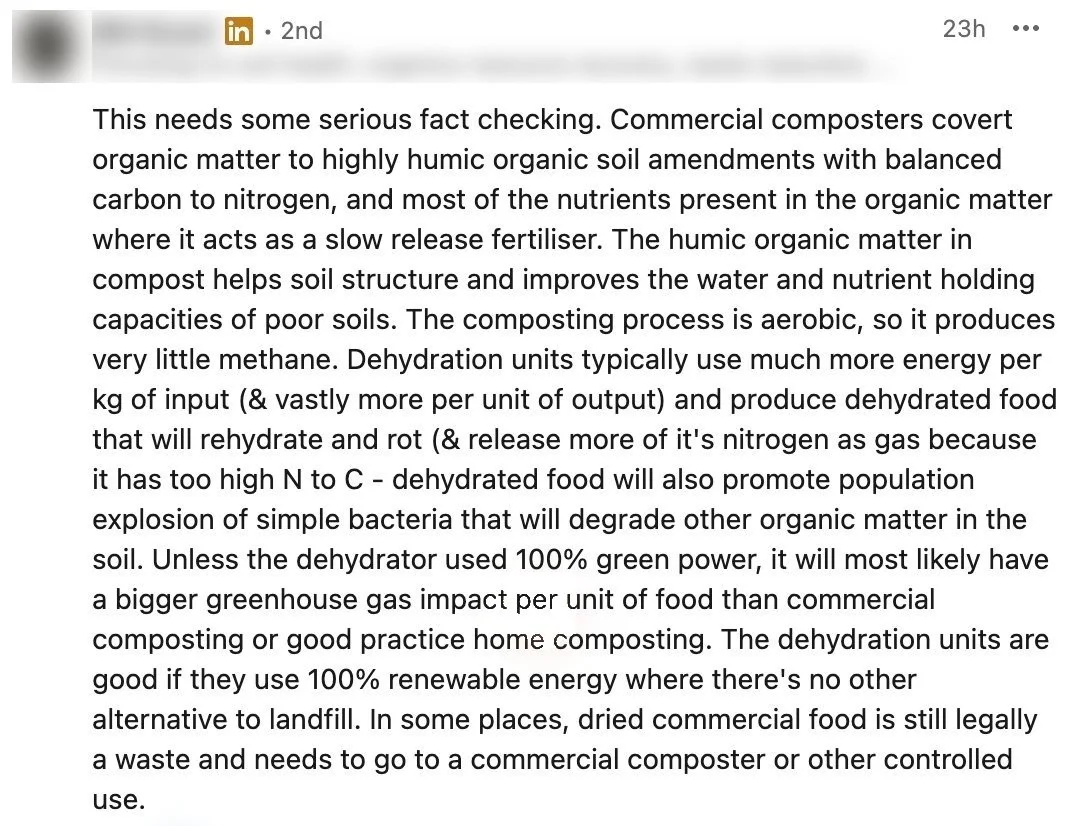
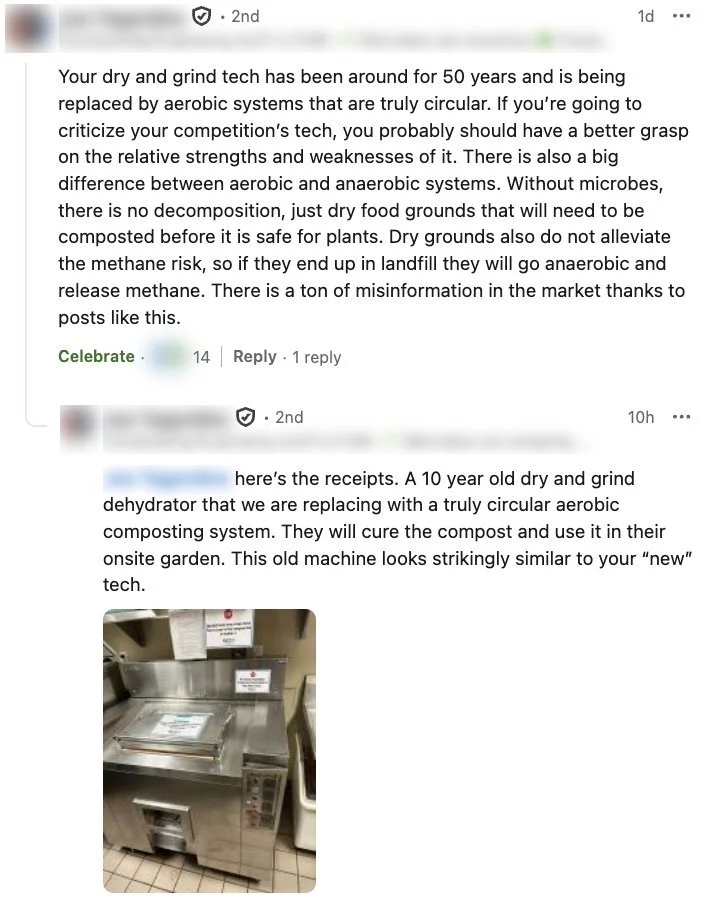
Real public responses to dehydrator marketing claims, with names removed. The consensus is consistent: without microbes there is no decomposition, dried food waste rehydrates and rots, and stabilising waste is not the same as recycling it.
The point isn’t to single anyone out. It’s that the people who study this for a living keep arriving at the same conclusion we did. Stabilising waste and recycling it are not the same thing.
Frequently Asked Questions
Is a food waste dehydrator the same as a composting machine?
No. A dehydrator uses heat to remove water from food waste, producing a dry, sterile powder. A composting machine uses aerobic microbial decomposition to produce living compost. The two outputs look similar in marketing photos but behave completely differently in soil, and lab testing tells them apart immediately.
Can dehydrator output be used as fertiliser?
Not in any meaningful way. Dehydrator output contains no living microbes, no nutrient cycling capacity, and very limited agricultural value. Once it rehydrates in the ground it simply begins decomposing as raw food waste would. Genuine compost shows measurable microbial activity, balanced nutrients, and high organic matter content in laboratory analysis.
Are food waste dehydrators sustainable?
They reduce waste volume and transport emissions, which has some value. But sustainability requires returning organic matter to the natural cycle. Because dehydrator output is biologically dead and often still ends up in landfill, a dehydrator on its own cannot honestly be labelled a sustainable solution.
How do I know if a machine produces real compost?
Ask what the machine produces, ask to see and touch the output from a working installation, and ask for current, independent lab results showing microbial activity and nutrient content. If the manufacturer can’t provide them, you’re looking at a dehydrator, whatever the brochure says.
Shiva Industries builds Indonesia’s most advanced rapid composting machines in Denpasar, Bali. Every machine produces lab-tested, living compost, backed by our in-house laboratory, periodic Sucofindo validation, Udayana University R&D partnerships, and same-day local service. Request a site assessment at shivaindustries.tech/contact.
