
Waste management creates costs. Resource recovery creates value.
Our founder Tobias Wilson put a question on LinkedIn this week that he can't shake: if we already grow enough food and throw a third of it away, who exactly is "more" for?¹ Read that first, it's the why. This is the what. The War on Sampah argued that Bali's plastic problem is an organic problem in disguise, and Incinerators Are the Landfills of the Sky dealt with the loudest false solution. This article goes one step further. It argues that the phrase "waste management" is the reason we keep losing, because management only ever creates costs.
The hole in the bucket
Start with the number. Around 1.3 billion tonnes of food a year never gets eaten.² The UN's 2024 count puts retail, restaurant and household waste at just over a billion tonnes on its own, sixty percent of it from households.³ Food loss and waste sit behind eight to ten percent of global greenhouse gas emissions and cost about a trillion US dollars a year.⁴
That's the global picture. Now bring it home. Bali generates about 1.25 million tonnes of waste a year and roughly 60 percent of it is organic.⁵ Call it 750,000 tonnes of food scraps, garden cuttings and market leftovers. Fifty-two percent of the island's waste is mismanaged: 22 percent dumped inland, 19 percent burned in the open, 11 percent leaking into rivers and out to sea.⁵ Only 4 percent is recycled.⁵
Read those numbers again and notice what they have in common. Every one of them is about where the waste goes. None of them is about what the waste is. That's the tell. We've built an entire industry, a set of laws and a whole vocabulary around moving material from where it's made to where it can be forgotten. We call it waste management. It's a logistics problem with a landfill at the end, and the landfill is now closed.
Management creates costs. Recovery creates value.
Here's the difference in one sentence. Waste management asks "where do we put this?" Resource recovery asks "what's in this, and how do we get it out before it does damage?"
Because that's the choice. A banana peel in a mixed bin isn't neutral. It leaks, it smells, it soaks the cardboard and plastic around it and turns the whole bag into something nobody will buy. Then it goes to a hole, rots without oxygen and comes back as methane, a gas that warms the planet many times harder than the carbon dioxide it would have released in a compost heap. One wet peel doesn't just cost you the peel. It costs you the bin, and then it costs everyone downwind. That's management. Every step adds a cost and nothing comes back.
The same peel, processed at the kitchen door, is carbon, nitrogen, potassium and a few billion microbes. Soil in waiting. The plastic and cardboard it was going to ruin stay clean, dry and sellable. Udayana University's flow study in Tabanan found only 5 to 7 percent of what Bali throws away is true residue with no further use.⁵ Everything else is a resource in the wrong place. That's recovery. Every step pulls value out of something that was about to turn on us.
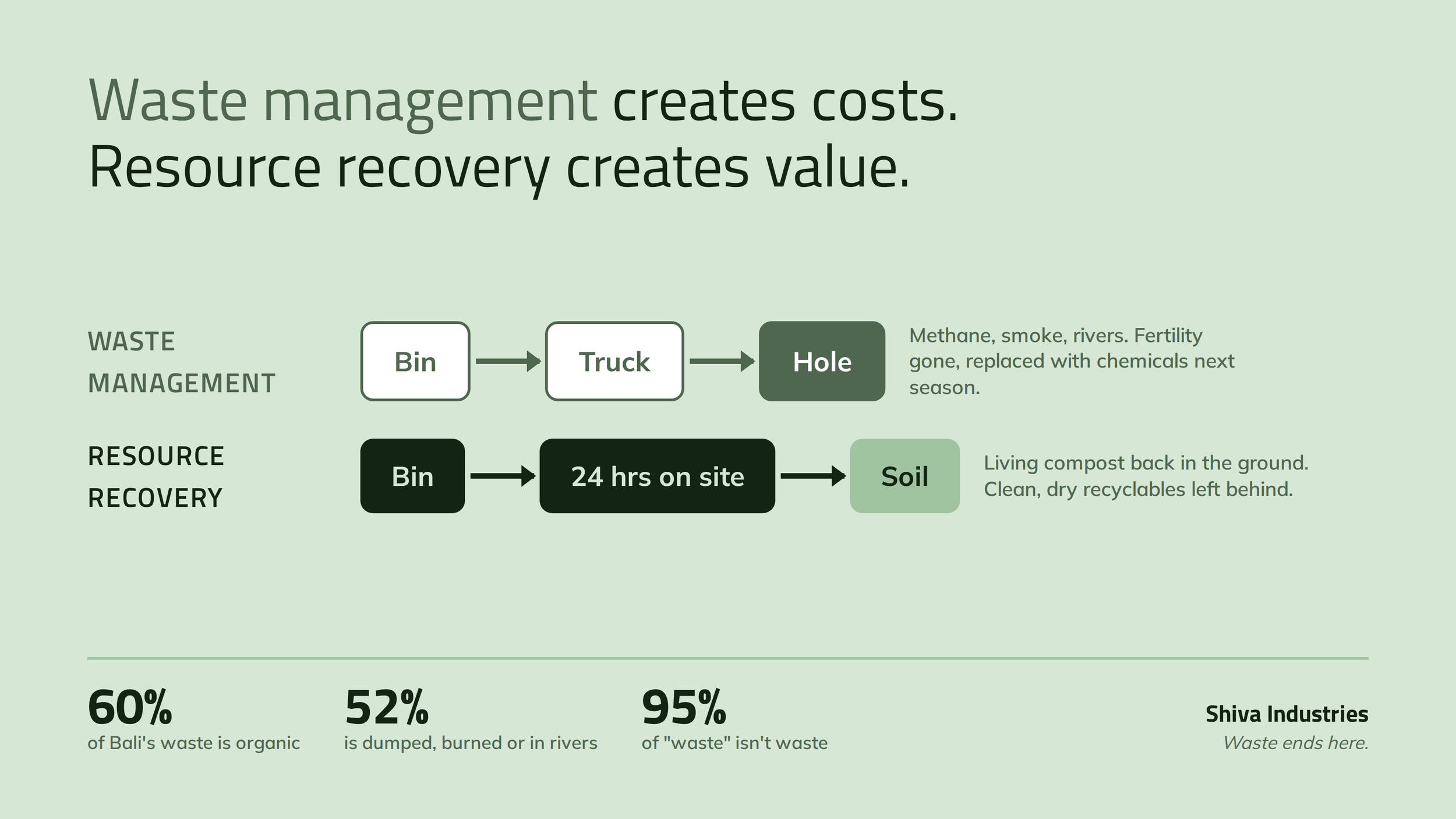
Management creates costs. Recovery creates value.
That's the whole argument for source separation, and it's why it sits at the centre of anything that actually works. Separate organics where they're made and the rest of the system unlocks itself. Keep them mixed and you can build as many transfer stations, incinerators and recycling plants as you like. They'll all be processing sludge.
What we don't need
More landfill. TPA Suwung stopped accepting organic waste on 1 April 2026 and closes completely in August 2026.⁶ Nationally, the Ministry of Environment has ordered an end to open dumping at 343 landfills, with criminal exposure for regions still doing it after July 2026.⁷ The hole is closing. Burying it is no longer a plan, it's a memory.
Incinerators. Landfills of the sky. You don't destroy 750,000 tonnes of wet organics by burning them. Food waste is 65 to 75 percent water, so you're paying to boil it, and what's left is ash, emissions and a very large electricity bill.
Waiting for a truck. Collect-and-haul is the most expensive option on both cost and climate, and since April 2025 it's also a licence problem. Surat Edaran Gubernur Bali Nomor 9 Tahun 2025 requires businesses to manage their waste at source, with licence revocation as the sanction for those that don't.⁸
What works
Separate at source. Two bins. That's it. Organics in one, everything else in the other. Established decentralised systems divert 75 to 90 percent of waste from landfill, and 80 to 95 percent where enforcement holds.⁵ None of them start anywhere but here.
Process organics where they're produced. Enclosed aerobic digestion turns food waste into living compost in 24 hours, on site, with no leachate, no exhaust and no sludge. It slashes methane against landfill (low-methane, not zero) and gives the site a logged, dated, verifiable record of every kilo for regulators and ESG reporting. The microbes do the work exothermically, so the water leaves as vapour from a biological process rather than a heating element, and volume drops by 80 to 90 percent.
Put the output back in the ground. This is the part "waste management" never gets to. The Westin Resort Nusa Dua has run a 750 kg per day machine continuously since August 2024. It has replaced chemical fertiliser across the whole property with its own compost, revived dormant plantings, and done it with regular hospitality staff. Two years, no truck, no chemicals, and the garden is better. That's what recovery looks like when it's finished.
Why now, not next budget cycle
Because the air, the water and the soil are the three things nobody can buy more of, and all three are being paid with right now. Open burning of organics puts smoke into lungs. Rivers carry the dumped fraction to the reef and the beach that the island's tourism economy sits on. And every tonne of compost that goes to landfill instead of the ground is a tonne of soil fertility replaced with a bag of chemicals next season. The regulation has caught up. The landfill has closed. The only thing left to move is the decision.
Marching orders
Households. Two bins. Compost what you can. Ask your banjar where the organics go and don't accept "the truck" as an answer.
Businesses. Weigh your waste for a week. If it's more than 100 kg a day of organics, you have a regulatory exposure and a resource you're paying someone to take away. Process it on site.
Government. Enforce separation, fund it at banjar level, and stop counting tonnes moved as tonnes managed. Count tonnes recovered.
FAQ
What's the difference between waste management and resource recovery?
Waste management moves material to where it can be disposed of. Resource recovery keeps the value in the material, by separating it at source and turning it into something useful: compost from organics, clean sellable plastic and paper from the dry stream.
Why is organic waste the priority in Bali?
Because it's around 60 percent of the stream⁵ and it contaminates everything it touches. Process organics at source and the recycling rate for everything else rises without any other change.
Doesn't composting take months?
Traditional composting takes 10 to 12 weeks and a lot of land. Enclosed rapid aerobic digestion takes 24 hours in a footprint the size of a storeroom, indoors, next to a working kitchen.
What happens to the compost?
It goes back into the ground. Hotels use it on their own grounds in place of chemical fertiliser. It's the base a fertiliser is built from rather than a finished product, and it has been analysed by PT Sucofindo against the SNI 7763 method.
Waste ends here. If you run a hotel, restaurant, market, school or hospital producing more than 100 kg of organic waste a day, book a free on-site waste audit at shivaindustries.tech/contact.
References
Tobias Wilson, LinkedIn: "We already grow enough. So who is 'more' for?"
UN News / FAO, 2011: More than 1 billion tons of food lost or wasted every year
UNFCCC: Food loss and waste account for 8 to 10 percent of global emissions
Shiva Industries, Waste Ends Here: Decentralised Waste Management in Bali, April 2026
JPNN Bali: TPA Suwung stops accepting organic waste from 1 April 2026 and Balipost: Koster confirms full closure August 2026
Tempo: 343 of 550 TPA still open dumping and Espos: criminal sanctions for open dumping after July 2026
ANTARA: Koster says businesses in Bali can lose their licence for not managing waste and SE Gubernur Bali Nomor 9 Tahun 2025, full text
